Insured Worldwide Shipping | Certified Authenticity
Who Owns Your Watch Brand? The Ultimate Guide

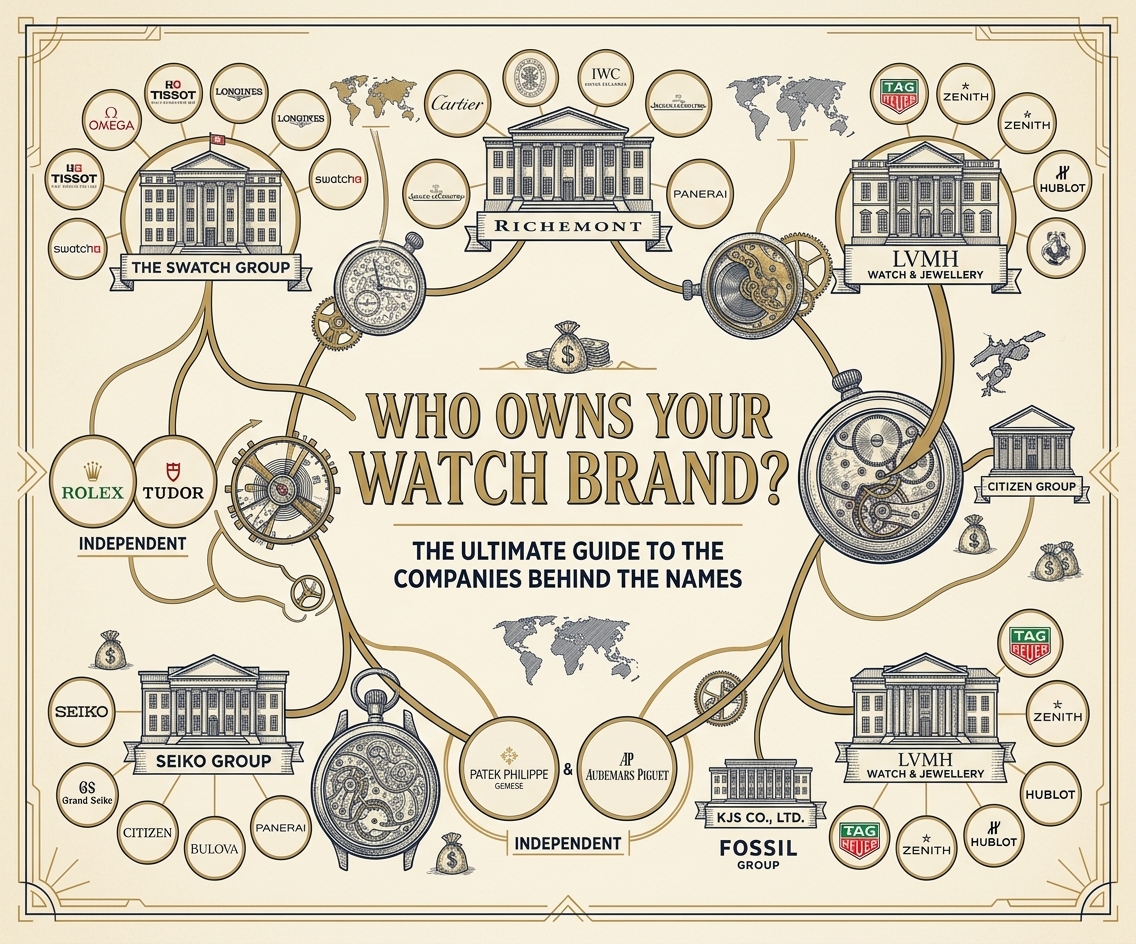
Who Owns Your Watch Brand? The Ultimate Guide to the Companies Behind the Names
When you buy a watch, you usually choose a brand you recognize. Perhaps it is a Seiko, Citizen, Bulova, Fossil, or Omega. But have you ever wondered who actually owns the company behind the name on your dial?
The answer can be more surprising than you might expect.
Some watch brands belong to enormous international groups that own dozens of labels across different price categories. Others are part of specialist watchmaking companies, while a select number remain independent businesses with their own management, identity, and traditions.
Understanding these relationships can help you discover new brands, explore different price ranges, and learn more about the watch industry.
In this guide, we explore who owns some of the world’s best-known watch brands, how these corporate relationships work, and why ownership is not the same thing as the company that actually manufactures a watch.
Why Do Watch Brands Belong to the Same Company?
The watch industry is built around a mixture of heritage, technology, design, and business strategy.
A large watchmaking group may own several brands because each serves a different audience. One brand might focus on affordable everyday watches, another on mechanical watches for enthusiasts, and another on luxury timepieces.
Owning multiple brands can allow a group to share research, manufacturing resources, distribution networks, and technical expertise while maintaining distinct identities for each label.
However, a shared owner does not mean that every watch is designed, engineered, or manufactured in the same place. Different brands may operate independently, use different movements, and maintain separate production facilities.
It is also important to distinguish between four different relationships:
- Parent company: The business that owns or controls another company.
- Subsidiary or affiliated brand: A company or brand operating within a larger corporate group.
- Product line: A collection within a brand, rather than a separate company.
- Licensed brand: A name used on watches under a licensing agreement, where the trademark owner and the company producing or distributing the watches may be different.
These distinctions are essential when researching the history and identity of a watch.
1. Citizen Group: More Than Citizen Watches
Japan’s Citizen Watch Co. is one of the world’s major watchmaking companies. Although Citizen is best known for its own watches and Eco-Drive technology, its corporate family extends well beyond the Citizen name.
Citizen
Citizen produces watches across a wide range of prices and styles, from everyday quartz models to mechanical watches and technologically advanced timepieces.
Its Eco-Drive technology, which converts light into energy, is one of the brand’s best-known innovations.
Q&Q
Q&Q is associated with Citizen and is known for affordable, practical watches designed for everyday use.
The brand is particularly relevant to buyers looking for straightforward, accessible timepieces rather than luxury products.
Q&Q is a good example of how a major watchmaking group can serve a different market segment through another brand identity.
Bulova
Bulova began in the United States in 1875 and developed a long history of watchmaking innovation. The company became part of Citizen in 2008.
Today, Bulova maintains its own identity, with collections ranging from accessible watches to more distinctive designs and historically inspired models.
Its Precisionist technology and the Accutron legacy are important parts of its story.
Frederique Constant and Alpina
Citizen acquired Swiss watchmaker Frederique Constant and its sister brand Alpina in 2016.
Frederique Constant is known for its approach to accessible Swiss luxury, including mechanical watches and in-house movements in selected models.
Alpina focuses on sports-oriented watches, with a history connected to outdoor activities and robust timekeeping.
Both brands retain distinct identities despite belonging to the same wider group.
Arnold & Son
Arnold & Son is a high-end watchmaking name associated with English watchmaking heritage and Swiss production.
It belongs to the wider Citizen Group through its Swiss watchmaking operations, rather than being simply another Citizen-branded collection.
The key takeaway: Citizen’s corporate family includes brands with very different histories, designs, and price levels. Buying a Bulova or Frederique Constant is not the same as buying a Citizen, even though the businesses are connected.
2. Seiko: A Japanese Watchmaking Family
Seiko is one of the most influential names in modern watchmaking. Its history includes innovations in quartz technology, mechanical watches, and precision timekeeping.
However, several related names in the wider Seiko world need to be distinguished carefully.
Seiko
Seiko offers watches ranging from affordable everyday models to sophisticated mechanical and high-end timepieces.
Its collections include the Seiko 5 Sports family, Prospex, Presage, and other lines serving different types of buyers.
These are collections within Seiko, not separate independent watch companies.
Grand Seiko
Grand Seiko was established in 1960 as a premium expression of Japanese watchmaking.
It became an independent brand within the Seiko corporate family in 2017, with its own identity, design language, and focus on precision and finishing.
Grand Seiko is not simply a more expensive Seiko collection today. It operates as a distinct brand, even though it remains connected to the broader Seiko corporate heritage.
Pulsar and Lorus
Pulsar and Lorus are names associated with Seiko’s more accessible watch market.
They have offered affordable quartz watches and designs aimed at buyers who want practical timekeeping without paying luxury prices.
Their exact corporate arrangements and product ranges can change over time, so they should not automatically be described as separate independent manufacturers.
Orient
Orient is especially interesting to mechanical-watch enthusiasts because it has its own history and watchmaking identity.
The brand became part of Seiko Epson in 2009. Seiko Epson and Seiko Watch Corporation are separate companies within the broader Seiko corporate landscape.
Orient is therefore related to the wider Seiko world, but it is not simply a Seiko Watch Corporation product line.
Orient Star
Orient Star is Orient’s more premium line, known for mechanical watches with additional finishing and complications in selected models.
It is best understood as a premium family within the Orient brand rather than a completely unrelated company.
The key takeaway: Seiko, Grand Seiko, Orient, and Orient Star have important relationships, but their brand structures are not identical. Understanding the differences makes it easier to appreciate what each name represents.
3. Fossil Group: Fashion, Design, and Accessible Watches
Fossil Group built its reputation around watches, accessories, and lifestyle products. It has also owned or developed several other watch and fashion-accessory brands.
Fossil
Fossil became known for combining accessible pricing with designs influenced by vintage aesthetics and contemporary fashion.
Its collections include quartz and mechanical watches, as well as leather goods and accessories.
Relic
Relic is associated with Fossil Group and is known for affordable watches with accessible, fashion-oriented designs.
It is a useful example of a secondary brand serving a different price point from its better-known corporate relative.
Skagen
Skagen was founded around Danish-inspired minimalist design and became part of Fossil Group in 2012.
Its watches are recognized for clean dials, restrained styling, and an emphasis on simplicity.
Michele
Michele focuses on fashion-forward luxury watches, particularly designs aimed at the women’s watch market.
Its products often combine watchmaking with jewelry-inspired styling.
Zodiac
Zodiac has a history dating back to 1882 and is particularly associated with Swiss sports watches, including the Sea-Chron and Super Sea Wolf traditions.
The brand became part of Fossil Group in 2001.
Although these brands share a corporate connection, their positioning is different. Fossil and Relic emphasize accessibility, Skagen focuses on minimalist design, Michele combines watches with jewelry aesthetics, and Zodiac draws on Swiss sports-watch heritage.
The key takeaway: A brand’s corporate owner can help explain its business resources, but it does not automatically determine its design, heritage, or appeal to collectors.
4. Swatch Group: One Owner, Many Swiss Watch Brands
Swatch Group is one of the most important groups in the Swiss watch industry.
Its portfolio includes brands at very different price levels, from accessible watches to some of the world’s most prestigious mechanical timepieces.
Among its principal watch brands are:
- Swatch: Colorful, accessible watches with a strong design identity.
- Tissot: Swiss watches spanning everyday models, sports watches, and mechanical pieces.
- Hamilton: A brand with American origins and a strong modern Swiss watchmaking presence.
- Mido: Swiss watches known for classic designs and mechanical collections.
- Certina: Sports-oriented watches with a long history of robust construction.
- Rado: Watches recognized for design and materials, including high-tech ceramics.
- Longines: A historic Swiss brand with an extensive heritage in sports timing and elegant watches.
- Omega: A major luxury watchmaker associated with the Speedmaster, Seamaster, and Constellation families.
- Blancpain: A high-end watchmaker particularly associated with mechanical watches and the Fifty Fathoms.
- Breguet: A historic luxury name with important connections to the development of watchmaking.
- Glashütte Original: A German watchmaker operating within the group.
These are separate brands, not merely collections of one large Swatch watch brand.
A Tissot and an Omega may share the same corporate owner, but their pricing, finishing, movements, market positioning, and brand histories differ substantially.
Swatch Group’s portfolio demonstrates why it is misleading to judge a watch solely by the name of its parent company.
5. LVMH: Luxury Brands Under One Roof
LVMH is a major luxury-goods group with interests in fashion, jewelry, spirits, hospitality, and watches.
Its watch-related portfolio includes several well-known names.
TAG Heuer
TAG Heuer is closely associated with motorsport, chronographs, and sports watches. The brand is part of LVMH and maintains its own identity within the group.
Hublot
Hublot is known for bold contemporary designs, distinctive materials, and the Big Bang collection.
Its position within LVMH connects it to a wider luxury network while preserving a recognizable visual identity.
Zenith
Zenith has a long history of Swiss watchmaking and is particularly known for the El Primero chronograph movement.
The brand is also part of LVMH.
Bulgari
Bulgari is a luxury jewelry and watch brand with Italian origins and a significant Swiss watchmaking operation.
Its Octo collection demonstrates how the brand combines architectural design with high-end watchmaking.
These names share a corporate parent, but they address different customers and express different approaches to luxury.
6. Richemont: A Major Force in Luxury Watchmaking
Richemont owns or controls a portfolio of luxury brands across watches, jewelry, and other luxury goods.
Its watchmaking names include:
- Cartier: Famous for iconic designs such as the Tank and Santos, as well as its jewelry heritage.
- IWC Schaffhausen: Known for pilot’s watches, engineering-focused designs, and mechanical timepieces.
- Jaeger-LeCoultre: A historic manufacture with a reputation for mechanical innovation and complications.
- Panerai: Recognized for bold cases, Italian naval heritage, and the Luminor and Radiomir collections.
- A. Lange & Söhne: A prestigious German watchmaker associated with exceptional finishing and mechanical sophistication.
- Piaget: A luxury brand known for elegant watches, jewelry, and ultra-thin movements.
- Vacheron Constantin: One of the oldest continuously operating watch manufacturers, with a long history of high-end watchmaking.
- Baume & Mercier: A Swiss watch brand focused on accessible luxury.
- Roger Dubuis: A high-end watchmaker known for expressive designs and complicated movements.
- Montblanc: A luxury brand with a broader portfolio that includes watches.
These brands share a corporate group but have different origins, manufacturing traditions, and identities.
For collectors, the distinction matters: corporate ownership does not make the Tank, Portugieser, Reverso, and Lange 1 interchangeable products. Each has its own design and watchmaking story.
7. Movado Group: Beyond the Movado Name
Movado Group is another example of a company with a varied portfolio of watch and accessory brands.
Its brand portfolio has included:
- Movado: Known for minimalist designs, especially the Museum dial.
- Concord: A luxury watch name with a long history.
- Ebel: A Swiss watch brand known for elegant designs and jewelry-influenced styling.
- MVMT: A contemporary lifestyle brand associated with accessible watches and accessories.
- Olivia Burton: A fashion and accessories brand known for decorative designs.
Movado Group has also produced watches under licensing agreements for other well-known fashion and lifestyle names. Such arrangements are different from owning the underlying fashion brand.
Because licensing contracts and brand portfolios can change, the company responsible for a particular watch collection should be checked against current information.
8. Rolex and Tudor: A Different Kind of Relationship
Rolex offers a particularly interesting example because its relationship with Tudor differs from the structure of a large multi-brand group such as Swatch Group.
Rolex was founded in 1905 and became one of the world’s best-known luxury watchmakers. Tudor was established by Hans Wilsdorf in 1946 as a related brand offering watches with a different market position.
Tudor is part of the same corporate ownership structure as Rolex, through the Hans Wilsdorf Foundation.
Historically, Tudor used a number of components and movements sourced from other manufacturers, while developing its own identity. Today, Tudor offers watches with a growing range of Manufacture Calibres as well as other movement arrangements.
Rolex and Tudor share important historical connections, but they are distinct brands with different product strategies and price points.
This is a good reminder that two related brands do not have to be positioned at the same level of the market.
9. Watch Brands That Remain Independent
Not every major watchmaker belongs to a large luxury group.
Some important brands remain independent or are controlled by their founders, families, or private ownership structures.
Patek Philippe
Patek Philippe is a family-owned, independent Swiss watchmaker renowned for complicated mechanical watches, finishing, and long-term collectability.
Its independent status is an important part of its identity.
Audemars Piguet
Audemars Piguet remains an independent, family-controlled Swiss luxury watchmaker. The Royal Oak is its most recognizable collection, but the brand’s history extends far beyond that model.
Richard Mille
Richard Mille is known for contemporary high-end watches, advanced materials, and distinctive case designs. It operates outside the major watch groups discussed above, although its ownership structure should be distinguished from the idea of a completely founder-owned business.
Independence does not automatically mean better quality, and corporate ownership does not automatically mean lower quality. What matters is how each company develops its products, maintains its standards, and serves its customers.
10. Does the Owner of a Watch Brand Matter When Buying a Watch?
Yes, but perhaps not in the way many buyers expect.
The parent company can provide useful context about a brand’s resources, distribution, and place in the industry. It can also help explain why two brands have similar technologies or overlapping price categories.
However, the owner’s name alone cannot tell you whether a particular watch is good.
When comparing watches, consider the following:
Movement: Is it quartz, automatic, manual-winding, solar-powered, or another type? Who makes it, and what are its specifications?
Materials and construction: Examine the case, crystal, bracelet, water resistance, finishing, and overall build quality.
Service and parts: Consider the availability of authorized service, replacement components, and qualified independent watchmakers.
Heritage and design: A brand’s history can be meaningful, but it should be assessed alongside the actual watch.
Price and value: Compare specifications, condition, warranty, resale demand, and the prices of comparable models.
Authenticity: When buying a pre-owned or vintage watch, investigate its serial numbers, reference, movement, components, and service history where available. A famous logo alone is not proof of authenticity.
A well-chosen watch should make sense on its own merits, regardless of which corporation owns its brand.
Final Thoughts: The Name on the Dial Is Only Part of the Story
The watch industry is a fascinating combination of independent watchmakers, historic manufacturers, luxury conglomerates, and accessible brands.
Citizen is connected to names such as Bulova and Frederique Constant. Seiko’s wider corporate landscape includes distinct brands such as Orient and Grand Seiko. Fossil Group has had a varied portfolio that includes names such as Skagen and Zodiac. Meanwhile, Swatch Group, LVMH, and Richemont bring together many different watchmaking traditions under large corporate structures.
Yet ownership is only one part of a brand’s story.
A watch’s appeal comes from its design, movement, engineering, history, quality, and the experience it offers its owner. Understanding who owns the name can make the industry easier to navigate, but it should be the beginning of your research rather than the end.
At Watch Chronicles, we believe that every watch has a story worth exploring — from affordable everyday timepieces to historic vintage models and exceptional mechanical watches.
The next time you look at a watch, ask yourself two questions: who stands behind the brand, and what makes the watch itself worth knowing?
That is where the real story begins.
Editorial note: Corporate ownership, brand portfolios, and licensing arrangements can change. Readers researching a purchase should verify current ownership and product details with the relevant company or official brand source.