Insured Worldwide Shipping | Certified Authenticity

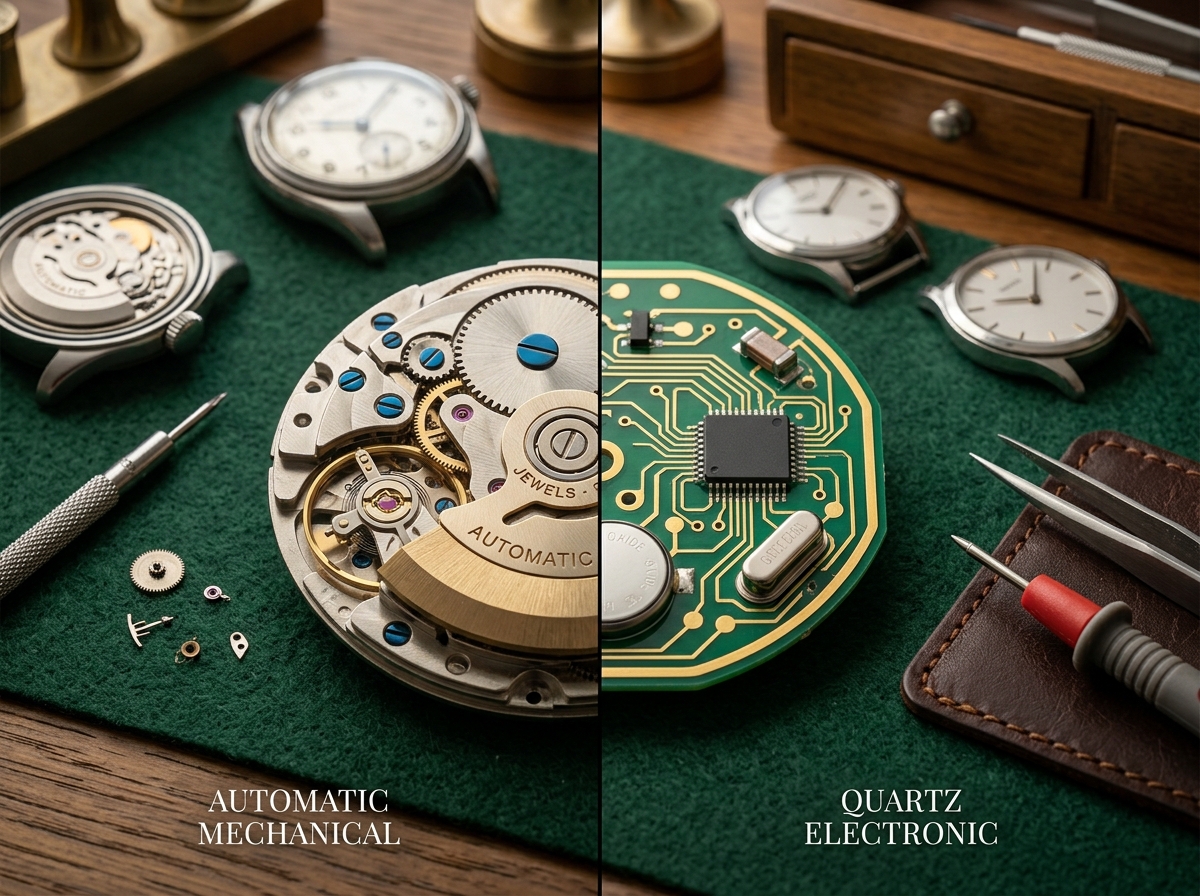
Automatic vs. Quartz Watches: Which Is Better for You?

Choosing a watch involves more than deciding on a brand, dial colour or case size. One of the most important decisions happens inside the watch itself: should you choose an automatic movement or a quartz movement?
Both types can offer excellent design, reliability and years of enjoyment, but they work in different ways. They also have different strengths when it comes to accuracy, maintenance, cost and the experience of wearing a watch.
For some people, the appeal of an automatic watch lies in its mechanical complexity and traditional craftsmanship. Others prefer quartz because it is accurate, practical and usually easier to maintain.
So, which is better?
The answer depends on what you expect from your watch. This guide explains the differences between automatic and quartz watches and helps you decide which one makes the most sense for your lifestyle.
What Is an Automatic Watch?
An automatic watch is a mechanical watch that winds itself through the natural movement of your wrist.
Inside the case, a weighted component called a rotor moves as you wear the watch. This movement winds the mainspring, which stores energy and gradually releases it to power the mechanism.
A series of carefully engineered components regulates that energy, allowing the hands to move and the watch to measure time.
Unlike a quartz watch, a traditional automatic watch does not rely on a battery to power its timekeeping mechanism.
Automatic watches are part of the wider family of mechanical watches. The other major type is the manual-winding watch, which requires the wearer to wind the crown by hand rather than relying on an automatic winding rotor.
Why People Love Automatic Watches
For many enthusiasts, an automatic watch is more than a way to tell the time. It is a miniature mechanical system that can be appreciated, maintained and passed down.
Some of the most appealing features include:
- Mechanical craftsmanship: A traditional automatic movement contains many interacting components working together to measure time.
- No regular battery replacement: The watch is powered by stored mechanical energy rather than a conventional watch battery.
- A distinctive wearing experience: Wearing and winding a mechanical watch can become part of a daily routine.
- Exhibition casebacks: Some models allow you to see the movement working through a transparent caseback.
- Long-term appeal: A well-made mechanical watch can often be serviced and kept running for decades, depending on its design, condition and availability of parts.
Automatic watches are available at many price points, from accessible everyday models to highly sophisticated luxury timepieces.
However, a mechanical movement is not automatically superior simply because it is more complicated. Quality, regulation, construction and servicing all matter.
What Is a Quartz Watch?
A quartz watch uses an electronic circuit and a tiny quartz crystal to regulate timekeeping.
The battery supplies electrical energy to the circuit, which makes the crystal vibrate at a precise frequency. The circuit uses those vibrations as a timekeeping reference and controls the movement of the watch’s hands or digital display.
In a conventional analogue quartz watch, a small electric motor moves the hands. Many digital watches use electronic displays instead.
Quartz technology transformed the watch industry because it made accurate timekeeping available in affordable, compact and reliable watches.
Why People Choose Quartz Watches
Quartz watches are particularly attractive to people who want a dependable watch without much day-to-day attention.
Their advantages include:
- Excellent accuracy: Many ordinary quartz watches gain or lose only a small number of seconds per month, although performance varies by model.
- Low maintenance: They generally need less routine mechanical servicing than traditional mechanical watches.
- Convenience: Most continue running without being worn, provided the battery or power source has sufficient energy.
- Affordable options: Quartz movements are widely available in watches across a broad range of prices.
- Slim designs: Their construction can make very thin and lightweight watches possible.
Quartz does not necessarily mean inexpensive or poorly made. Premium quartz watches can feature exceptional finishing, advanced temperature compensation, high-accuracy movements and sophisticated technology.
Some solar-powered quartz watches use light to recharge an internal energy-storage cell, reducing or eliminating the need for conventional battery changes during normal use. Radio-controlled and GPS-enabled watches can offer additional timekeeping features.
Automatic vs. Quartz: The Main Differences
The table below summarises the practical differences between the two movement types.
| Feature | Automatic | Quartz |
|---|---|---|
| Power source | Wound mainspring | Usually a battery or rechargeable energy source |
| Timekeeping | Mechanical regulation | Electronic regulation using a quartz crystal |
| Typical accuracy | Often varies by several seconds per day | Often varies by only several seconds per month |
| When not worn | Usually stops when its power reserve runs out | Usually continues running while powered |
| Maintenance | Periodic mechanical servicing may be needed | Generally lower routine maintenance |
| Battery changes | Not required for a traditional mechanical movement | Usually required for standard battery-powered models |
| Sound and motion | Often has a smooth-looking seconds-hand sweep, depending on the movement | Many analogue models have a one-second tick |
| Price | Available from affordable to very expensive | Available from inexpensive to very expensive |
| Best suited to | Enthusiasts and people who appreciate mechanics | People who prioritise convenience and accuracy |
These are general comparisons, not absolute rules. Certain high-accuracy quartz watches can outperform ordinary quartz models by a substantial margin, while automatic movements differ widely in precision and construction.
Which Is More Accurate?
If accuracy is your main priority, quartz is usually the better choice.
A conventional quartz watch commonly operates within a range of roughly 10–20 seconds per month, although the manufacturer’s specifications should always be checked. Some high-accuracy quartz movements perform significantly better.
An ordinary mechanical watch may gain or lose several seconds per day. The exact result depends on the movement, regulation, position, temperature, state of wind and other factors.
This difference becomes noticeable over time. A quartz watch can often run for weeks with little deviation, while an automatic watch may need occasional correction.
For people who depend on precise timekeeping or simply dislike resetting a watch, quartz has a clear practical advantage.
Automatic watches, on the other hand, offer something different: the satisfaction of wearing a mechanical instrument whose timekeeping is produced by an intricate physical mechanism.
Which Requires Less Maintenance?
Quartz watches generally require less routine maintenance.
A standard battery-powered quartz watch will eventually need a battery replacement. Depending on the model and battery, this may be necessary every few years. Water resistance should also be checked when the watch is opened for service, particularly if it is regularly exposed to water.
Solar-powered quartz watches can operate for long periods without a conventional battery change, although their rechargeable cells may eventually need attention.
Automatic watches have more moving mechanical parts and may require professional servicing to clean, lubricate, inspect and regulate the movement. The recommended interval varies by manufacturer, movement and use.
Servicing costs can also vary considerably. A simple automatic movement may be relatively straightforward to service, while a complicated or high-end calibre can require specialist work and more expensive parts.
Neither type is maintenance-free. Straps, bracelets, seals, crystals and cases may all require care regardless of the movement inside.
Which Is More Durable?
There is no universal winner when it comes to durability.
A well-built quartz watch can be an excellent choice for everyday wear because it is accurate, convenient and generally requires less movement maintenance. Many quartz models are designed specifically for demanding environments.
An automatic watch can also be highly durable, particularly when it has a robust case, good shock protection and appropriate water resistance. However, its mechanical components can be sensitive to severe impacts and may require more attention over time.
Durability depends on the entire watch, not just the movement.
Before buying, consider:
- Case construction and materials.
- Water-resistance rating and the manufacturer’s guidance.
- Resistance to shocks and magnetic fields.
- Crystal type and ease of replacement.
- Availability of spare parts and qualified servicing.
- Whether the watch is intended for everyday wear, sport or occasional use.
A quartz watch is not automatically tougher than an automatic watch, and an automatic watch is not automatically fragile. The intended use and overall construction matter far more than the movement label alone.
Which Is Better Value for Money?
For straightforward timekeeping, quartz often offers excellent value. It is possible to buy a reliable quartz watch at a relatively low price and enjoy years of convenient use.
Automatic watches can cost more because of the complexity of their movements, assembly, regulation and finishing. They may also involve higher servicing expenses over their lifetime.
However, purchase price alone does not determine value.
A well-chosen automatic watch can provide years of enjoyment, and certain models develop strong collector followings. Quartz watches can also be highly desirable, particularly when they feature distinctive design, historically important technology or exceptional engineering.
It is important not to assume that every automatic watch will appreciate in value or that quartz watches cannot become collectible. Resale value depends on the individual model, condition, originality, demand, provenance and many other factors.
Buy the watch you genuinely want to wear rather than relying on a promise of future investment returns.
Automatic vs. Quartz: Which Should You Choose?
The best movement is the one that suits your habits and priorities.
Choose an Automatic Watch If…
An automatic watch may be right for you if:
- You enjoy mechanical engineering and traditional watchmaking.
- You like the idea of a watch powered by your movement.
- You appreciate mechanical details and visible movements.
- You enjoy interacting with your watch, including winding and setting it.
- You are comfortable with periodic servicing and slightly less precise timekeeping.
An automatic watch can make an ordinary daily ritual feel more personal. For many collectors, that experience is part of the pleasure.
Choose a Quartz Watch If…
Quartz may be the better choice if:
- You want accurate timekeeping with minimal effort.
- You rotate between several watches and want one that is ready to wear.
- You prefer lower routine maintenance costs.
- You need a dependable watch for work, travel or everyday activities.
- You want a practical option at a particular budget.
Quartz is also a sensible starting point for someone buying their first watch. It allows you to focus on design, comfort and personal taste without needing to learn the maintenance routines associated with mechanical movements.
What If You Want Both?
There is no reason to limit yourself to one movement type.
A quartz watch can be the practical everyday option, while an automatic watch can be the one you wear when you want to enjoy its mechanical character.
Many experienced collectors own both. They choose watches according to their needs, mood, outfit and occasion rather than believing one technology must always be better than the other.
What About Manual-Winding and Solar Watches?
Automatic and quartz are not the only options worth understanding.
A manual-winding mechanical watch uses a mainspring like an automatic watch, but it needs to be wound by hand. Some enthusiasts enjoy this daily interaction and the simplicity of a movement without an automatic winding rotor.
A solar-powered quartz watch uses light to generate electricity and store energy for the movement. It can be especially convenient for someone who wants quartz accuracy without frequent conventional battery changes.
There are also advanced quartz systems that use radio signals, GPS or other technologies to improve accuracy and convenience.
When comparing watches, read the manufacturer’s specifications rather than relying solely on the words printed on the dial.
Final Verdict: Automatic or Quartz?
Automatic and quartz watches serve different priorities, and both deserve a place in the modern watch world.
If you value mechanical craftsmanship, the experience of wearing a traditional movement and the pleasure of understanding how a watch works, an automatic watch may be the more rewarding choice.
If you value accuracy, convenience, affordability and minimal maintenance, quartz is usually the more practical option.
The best watch is not necessarily the most complicated, the most expensive or the most fashionable. It is the one that fits your life, feels right on your wrist and gives you a reason to enjoy wearing it.
After all, a watch should do more than measure time. It should mean something to the person wearing it.
Watch Chronicles
The Watch Journal — New releases, modern icons, pre-owned discoveries and vintage legends.
Editorial note: This article is intended as a general buying guide. Accuracy, maintenance requirements and durability vary by individual watch and movement. Always consult the manufacturer’s specifications for a specific model.