Insured Worldwide Shipping | Certified Authenticity

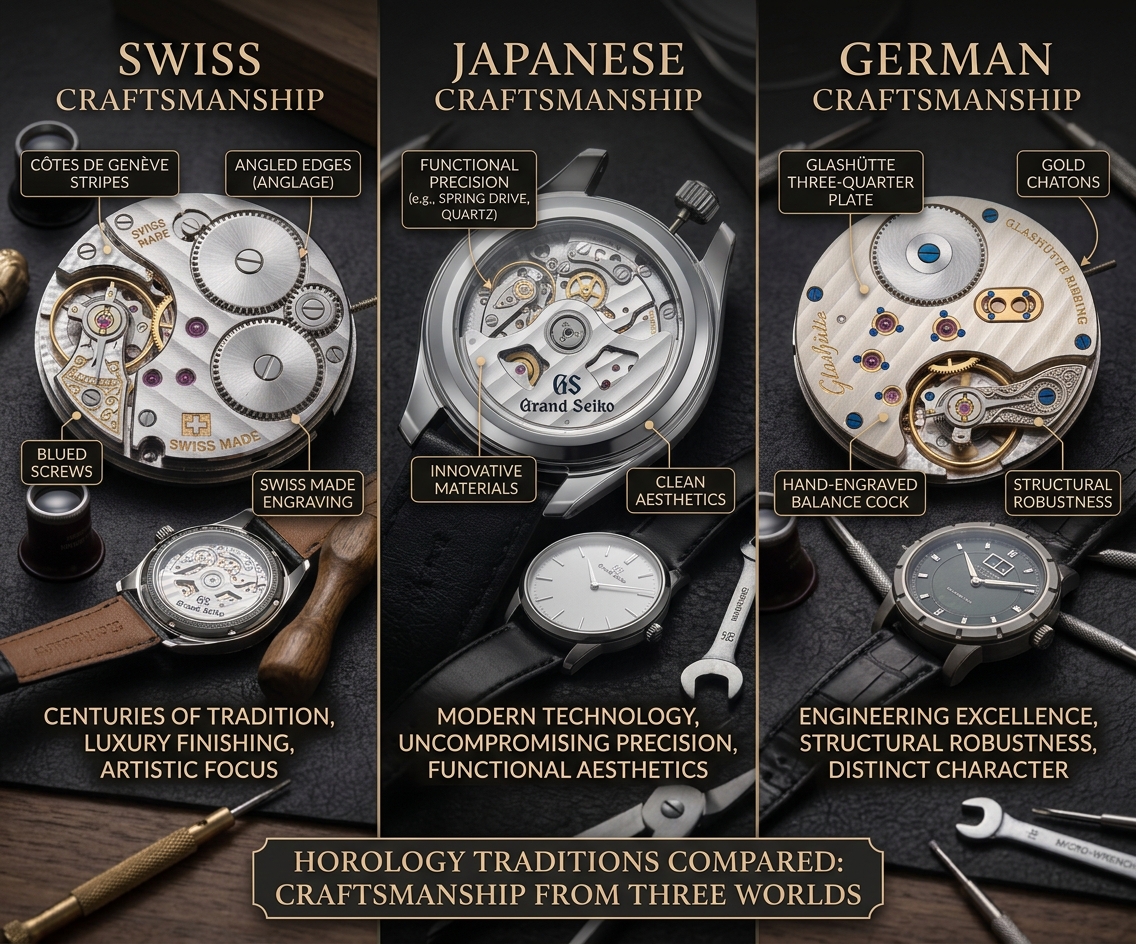
Swiss vs. Japanese vs. German Watches: What Makes Them Different?

When shopping for a watch, you will often encounter three major watchmaking traditions: Swiss, Japanese and German. Each has a distinct history, and each has contributed important innovations to the industry.
Swiss watches are frequently associated with luxury, traditional craftsmanship and mechanical expertise. Japanese watches are known for technological innovation, manufacturing scale and a wide range of prices. German watchmaking combines technical precision with design traditions that vary from understated everyday watches to highly complex luxury timepieces.
But are watches from one country actually better than those from another? Not necessarily. The most suitable watch depends on your budget, taste, intended use and expectations.
Here is what distinguishes these three watchmaking traditions — and what to consider before buying.
1. Swiss Watches: Heritage, Craftsmanship and Prestige
Switzerland has one of the world’s most influential watchmaking industries. Its reputation developed over centuries, with regions such as Geneva and the Jura Mountains becoming important centres of production.
Swiss watchmaking encompasses everything from accessible quartz watches to elaborate mechanical movements finished by hand. Although luxury mechanical watches receive much of the attention, Switzerland also has a strong history of mass production and electronic watchmaking.
What Makes Swiss Watches Special?
A long watchmaking tradition
Many Swiss manufacturers have histories stretching back generations. Their archives, established product lines and accumulated technical knowledge help preserve traditional watchmaking skills while allowing brands to develop new technologies.
Mechanical expertise
Switzerland is home to manufacturers specialising in mechanical movements, including automatic and manually wound calibres. Some movements are produced in-house, while other brands use movements supplied by specialist manufacturers.
An in-house movement can be an important technical achievement, but it is not automatically more accurate, reliable or serviceable than an externally sourced movement. The actual calibre and its quality matter more than the label alone.
Finishing and attention to detail
At the higher end of the market, Swiss watchmakers may invest considerable time in polishing, decoration, assembly and quality control. The degree of finishing varies significantly by brand, model and price.
International recognition
Swiss brands have helped establish some of the industry’s most recognisable watch designs. Their names can carry strong resale demand and brand prestige, although neither is guaranteed for every model.
Notable Swiss Watch Brands
- Rolex — Known for its recognisable designs, robust mechanical watches and strong market presence.
- Omega — Associated with professional timing, space exploration and sports timing, as well as luxury mechanical watches.
- Longines — Offers a broad range of traditional and contemporary watches.
- Tissot — Known for accessible Swiss watches across quartz and mechanical categories.
- Swatch — Helped popularise colourful, mass-market Swiss quartz watches.
These brands occupy different market segments. A Swatch and a Rolex share a country of origin, but they are designed for very different buyers and budgets.
What About the “Swiss Made” Label?
“Swiss Made” is a regulated designation, not simply a decorative phrase. Swiss watch regulations establish requirements concerning the movement, casing, final inspection and the proportion of manufacturing costs incurred in Switzerland.
However, the label does not mean that every component must be made in Switzerland or that every watch is assembled entirely by hand.
Best for: Buyers who value Swiss watchmaking heritage, a broad choice of mechanical watches, established luxury names and traditional design — provided the particular model suits their needs and budget.
2. Japanese Watches: Innovation, Reliability and Value
Japan transformed the global watch industry through manufacturing innovation, electronic timekeeping and the development of highly efficient production methods.
Japanese watchmakers produce inexpensive everyday watches, sophisticated mechanical models, advanced solar-powered timepieces and high-end luxury watches. This breadth makes Japan one of the most versatile watchmaking countries.
What Makes Japanese Watches Special?
Quartz innovation
Japanese manufacturers played a major role in the quartz revolution. Seiko introduced the Astron in 1969, widely recognised as the world’s first commercially available quartz wristwatch. Quartz technology brought a new level of accuracy and convenience to everyday timekeeping.
Practical engineering
Many Japanese watches are designed around reliability, usability and value. This can include straightforward movements, useful features, durable cases and accessible servicing options.
A wide range of technologies
Japanese brands offer far more than standard mechanical and quartz movements. Examples include Citizen’s Eco-Drive light-powered technology and Seiko’s Spring Drive, which combines a mechanical energy source with an electronic regulating system.
Spring Drive is especially interesting because it offers a distinctive approach to timekeeping that does not fit neatly into the usual mechanical-versus-quartz comparison.
Strong value across price ranges
Japanese watchmakers compete in entry-level, mid-range and premium markets. A relatively affordable model can offer useful specifications and thoughtful engineering, while luxury Japanese watches can feature intricate finishing and high-end movements.
Notable Japanese Watch Brands
- Seiko — Offers everything from accessible everyday watches to sophisticated mechanical and premium models.
- Citizen — Known for Eco-Drive technology, practical designs and a broad international collection.
- Casio — Famous for durable digital watches, including the G-Shock family.
- Orient — Recognised for accessible mechanical watches, including classic dress and diver-inspired designs.
- Grand Seiko — Combines detailed finishing, carefully considered design and high-precision movements in the premium segment.
Japanese watches should not be treated as a single category. A basic Casio digital watch, an Orient automatic and a Grand Seiko are very different products, even though they come from the same country.
Are Japanese Watches More Accurate?
Quartz watches are generally more accurate in everyday timekeeping than conventional mechanical watches, regardless of whether they are Japanese or Swiss.
Many Japanese quartz watches offer excellent accuracy for their price. However, the result depends on the specific movement and model. Some premium mechanical watches are also carefully regulated and tested to demanding standards.
Best for: Buyers looking for dependable everyday watches, practical technology, accessible prices, quartz innovation or high-quality mechanical alternatives across a wide range of budgets.
3. German Watches: Precision, Engineering and Distinctive Design
Germany has a smaller international watchmaking profile than Switzerland or Japan, but its watch industry includes respected manufacturers, specialist workshops and distinctive regional traditions.
Two important centres are Glashütte in Saxony and Pforzheim in Baden-Württemberg. They represent different parts of Germany’s watchmaking history and continue to contribute to the country’s modern industry.
What Makes German Watches Special?
Technical focus
Many German watchmakers emphasise legibility, functional design and carefully considered engineering. Some models feature unusual movement architecture or distinctive finishing techniques.
Distinctive aesthetics
German watch design is diverse. Some brands favour restrained dials, clean typography and minimalist cases. Others produce robust tool watches, traditional luxury pieces or highly complicated mechanical timepieces.
There is no single German design language, but functional clarity is an important characteristic of several well-known manufacturers.
Regional identity
Glashütte is especially significant in German mechanical watchmaking. The name is closely associated with a concentration of watch manufacturers and a regional tradition of movement construction and finishing.
Pforzheim has a different history, with strong connections to jewellery production, watch cases and the wider watch industry.
High-end craftsmanship and accessible options
Germany has both expensive luxury watchmakers and brands offering more accessible mechanical and quartz models. The price and level of finishing depend on the manufacturer and individual watch, not simply on its national origin.
Notable German Watch Brands
- A. Lange & Söhne — A prestigious Glashütte manufacturer known for elaborate mechanical movements and exceptional finishing.
- Glashütte Original — Produces luxury mechanical watches with strong links to Glashütte’s watchmaking tradition.
- NOMOS Glashütte — Recognised for clean, modern design and mechanical watches with a distinctive visual identity.
- Sinn — Known for functional tool watches and models designed around practical performance.
- Junghans — Offers a range of watches, including designs influenced by modernist and Bauhaus aesthetics.
These manufacturers demonstrate why it is difficult to describe German watches using a single set of characteristics. A minimalist NOMOS, a professional Sinn tool watch and a highly complicated A. Lange & Söhne represent very different approaches.
Best for: Buyers attracted to functional design, engineering-led details, distinctive aesthetics or German mechanical watchmaking — from practical tool watches to high-end collector pieces.
4. Swiss vs. Japanese vs. German: A Direct Comparison
The following comparison describes broad tendencies, not rules that apply to every watch.
| Feature | Swiss Watches | Japanese Watches | German Watches |
|---|---|---|---|
| Main associations | Heritage, luxury and mechanical expertise | Innovation, practicality and value | Engineering, functional design and regional craftsmanship |
| Movement options | Mechanical, automatic, manual and quartz | Mechanical, automatic, manual, quartz, solar and hybrid technologies | Mechanical, automatic, manual and quartz |
| Design | Traditional, sporty, elegant and contemporary | Broad variety, from digital to luxury mechanical | Often functional or restrained, but highly varied |
| Price range | Entry-level through ultra-luxury | Entry-level through high-end luxury | Accessible through high-end luxury |
| Accuracy | Depends on the movement and regulation | Many quartz models offer excellent accuracy | Depends on the movement and regulation |
| Main consideration | Brand prestige and model-specific value | Technology, practicality and range of choice | Design preferences and the specific manufacturer’s approach |
No country wins every category. A Japanese quartz watch may be more accurate than a Swiss mechanical watch, while a Swiss or German luxury movement may offer finishing or construction that a buyer particularly values.
The right comparison is between actual watches, not national reputations alone.
5. Which Country Makes the Best Watches for Your Budget?
Your budget can help narrow the choice, but it should not dictate the answer by itself.
If You Have a Modest Budget
Japanese manufacturers offer a particularly broad selection of affordable watches, including digital, quartz and automatic models. Casio, Citizen, Seiko and Orient are useful places to start exploring.
Swiss brands such as Tissot and Swatch also offer accessible options, while German brands have choices across different price points.
At this level, prioritise comfort, legibility, reliability, warranty and the cost of future servicing over prestige.
If You Want a Mid-Range Everyday Watch
Compare individual models from Seiko, Citizen, Orient, Tissot, Longines, Junghans, NOMOS Glashütte and other brands within your budget.
Think about how you will wear the watch. A simple quartz watch can be a sensible choice for someone who wants accurate timekeeping without regular winding, while an automatic watch may be more appealing if you enjoy mechanical engineering.
Check the case size, bracelet or strap, water resistance, movement specifications and service arrangements before deciding.
If You Are Shopping for a Luxury Watch
At higher price levels, all three traditions have compelling options.
Swiss brands offer a wide variety of established luxury models. Japanese high-end watchmaking, particularly Grand Seiko, provides an alternative perspective on finishing and precision. German manufacturers such as A. Lange & Söhne and Glashütte Original appeal to buyers interested in distinctive mechanical construction and finishing.
Compare the actual movement, materials, finishing, after-sales service and market price. Paying more does not automatically mean that a watch will be more accurate or better suited to your lifestyle.
6. Mechanical vs. Quartz: The Country Is Not the Whole Story
One common mistake is assuming that Swiss watches are mechanical, Japanese watches are quartz and German watches are exclusively mechanical.
All three countries have produced different types of movements. Swiss brands make quartz watches; Japanese manufacturers make sophisticated mechanical watches; and German companies offer a variety of movement technologies.
The difference between quartz and mechanical movements is often more relevant to everyday ownership than the country where the watch was made.
A quartz watch typically needs less routine attention and is usually more accurate. A mechanical watch can offer an engaging ownership experience, visible engineering and the pleasure of a traditional movement, but it generally requires periodic servicing.
Neither option is inherently better for everyone.
7. Does a Country of Origin Affect Resale Value?
It can influence buyer perception, but it is not a reliable predictor of resale value on its own.
Some Swiss luxury models attract strong demand on the secondary market. Certain Japanese models have dedicated collector communities, while particular German watches appeal to enthusiasts who value their movement design or limited production.
However, resale prices depend on many factors:
- Brand and exact reference
- Demand for the particular model
- Originality and condition
- Service history
- Availability of documentation and accessories
- Production numbers and market trends
- The price paid at the time of purchase
A watch should not be treated as a guaranteed investment simply because it comes from a prestigious country or manufacturer. Buy primarily because you appreciate the watch and can justify its cost.
8. What Should You Check Before Buying?
Regardless of origin, evaluate the individual watch carefully.
Movement: Understand whether it is quartz, automatic, manually wound, solar-powered or another type. Research the movement’s reputation and servicing requirements.
Condition: Look for damage, excessive polishing, corrosion, worn components and signs of poor repairs, especially when buying pre-owned.
Authenticity: Check the reference number, movement, case details and documentation where available. For an expensive purchase, consider an independent inspection by a qualified watchmaker or reputable specialist.
Service and warranty: Find out whether the watch is covered by a valid warranty and whether qualified servicing is available in your region.
Fit and comfort: Case diameter alone does not determine fit. Case thickness, lug-to-lug length, weight and bracelet design all affect how a watch wears.
Total ownership cost: Consider servicing, replacement parts, straps, batteries where applicable, insurance and potential import charges.
Seller reputation: Buy from a seller who clearly describes the watch’s condition, provides appropriate documentation and explains the return policy.
These practical checks are more useful than relying on country of origin as a shortcut for quality.
Final Verdict: Swiss, Japanese or German?
Swiss, Japanese and German watchmaking traditions each offer something worth exploring.
Choose Swiss if you are drawn to the country’s long watchmaking history, established luxury brands and broad selection of mechanical watches.
Choose Japanese if you value technological innovation, practical everyday design, accuracy in quartz watches and an impressive range of options at different price points.
Choose German if you appreciate engineering-led design, distinctive aesthetics and the country’s varied traditions — from functional tool watches to finely finished luxury movements.
But do not limit yourself to one country. A watch that fits your wrist, budget and lifestyle is a better choice than one selected only for its passport.
The most interesting way to explore watches is to compare individual models, learn what makes each one special and decide which details matter most to you.
At Watch Chronicles, we believe the best watch is not necessarily the most expensive or prestigious. It is the one you will enjoy wearing and understand well enough to appreciate.
Editorial note: Brand characteristics and product ranges vary by model and can change over time. Always confirm current specifications, warranty terms and servicing options with the manufacturer or an authorised retailer before purchasing.